Top 3 Performance Management Tools for Enterprise Goal Alignment
You're comparing performance management platforms because your current process leaves goals scattered across spreadsheets and quarterly reviews that arrive too late. Misaligned teams mean duplicated work and missed deadlines, and the cost shows up in your retention numbers. By the end of this article, you'll have three concrete criteria for evaluating enterprise goal alignment tools, a clear breakdown of how each platform handles OKR cascading and real-time tracking, and a definitive number-one pick that combines feedback, reviews, and goal management in one system.
We'll walk through what actually matters when your HR tech stack spans multiple departments, then examine HeyRamp, Betterworks, and Workboard against those standards. You'll leave knowing which tool fits your team size, budget, and existing infrastructure without needing a demo to figure it out.
What to Look For in Performance Management Tools for Enterprise Goal Alignment
When evaluating performance management tools for enterprise goal alignment, prioritize features that ensure objectives cascade from executive strategy to individual tasks while providing real-time visibility into progress. The right goal management platform turns strategic planning into daily execution, so every employee understands how their work contributes to business objectives.
Enterprise goal alignment fails when teams work in silos or track progress in disconnected spreadsheets. A unified system creates cross-functional collaboration and accountability, ensuring that department-level targets support the broader company mission rather than competing with it.
Look for performance management software that combines structured goal hierarchies with live data. The tool should support multiple OKR cycles, adapt to changing priorities, and give leaders an executive dashboard view of strategic execution across the organization.
OKR and Goal Cascading Capabilities
For enterprise goal alignment, a tool's OKR capabilities must allow you to create a clear hierarchy where every team's objectives roll up to company-wide strategic priorities. This cascading goals structure typically follows a path from executive-level objectives down to department, team, and individual key results.
When assessing OKR software, ask whether it supports parent-child objectives. This feature lets you link a department goal to a corporate objective while individual contributors connect their daily work to team targets. Without this linkage, alignment breaks down quickly.
An alignment score is another critical feature to evaluate. This metric shows how well objectives interconnect across functions, revealing whether marketing efforts support sales targets or if product development aligns with customer success goals. Ask vendors: "Can we see a visual map of how individual objectives contribute to top-level business objectives?"
Consider these questions during your evaluation:
- Can you establish multiple OKR cycles simultaneously, such as quarterly and annual?
- Does the tool offer an alignment matrix to spot gaps or redundancies in goal setting?
- Can you link objectives across departments for cross-functional initiatives?
- Does progress automatically roll up from individual to company level?
Best practice implementation starts with executive-level objectives and cascades downward. Leadership defines strategic priorities, then each department translates those into measurable key results. The goal management platform should make this process intuitive, not require manual updates at every level.
Real-Time Progress Tracking and Analytics
Real-time progress tracking ensures that any deviation from strategic targets is immediately visible, enabling timely course corrections. Live dashboards should display progress against key results with automatic updates from integrated tools, eliminating the need for manual status reports.
Evaluate the data refresh rate of any performance management tool you consider. Some platforms update hourly, while others lag by days. For enterprise goal alignment, fresher data supports proactive management rather than reactive reporting after targets have already slipped.
Customizable reporting matters for different stakeholders. Executives need executive dashboards showing company-wide health, managers require team-level views, and individual contributors benefit from personal progress tracking. Ask whether the tool lets each audience configure their own dashboard reporting experience.
Advanced analytics should go beyond simple status indicators. Look for trend analysis that shows momentum, velocity metrics that reveal pace of progress, and predictive insights that flag potential bottlenecks before they become critical. These workforce analytics capabilities separate basic trackers from strategic execution tools.
Integration with existing systems is essential. Your performance management software should connect with CRM platforms, project management tools, and HR systems so that KPI tracking pulls from authoritative data sources. This prevents duplicate entry and ensures consistency across the organization.
Finally, test the drill-down capability. A strong goal management platform lets you click from a company-level metric down to individual contributions, revealing exactly where misalignment or underperformance originates. This goal visibility enables managers to intervene early and keeps strategic execution on track.
1. HeyRamp - Best Overall
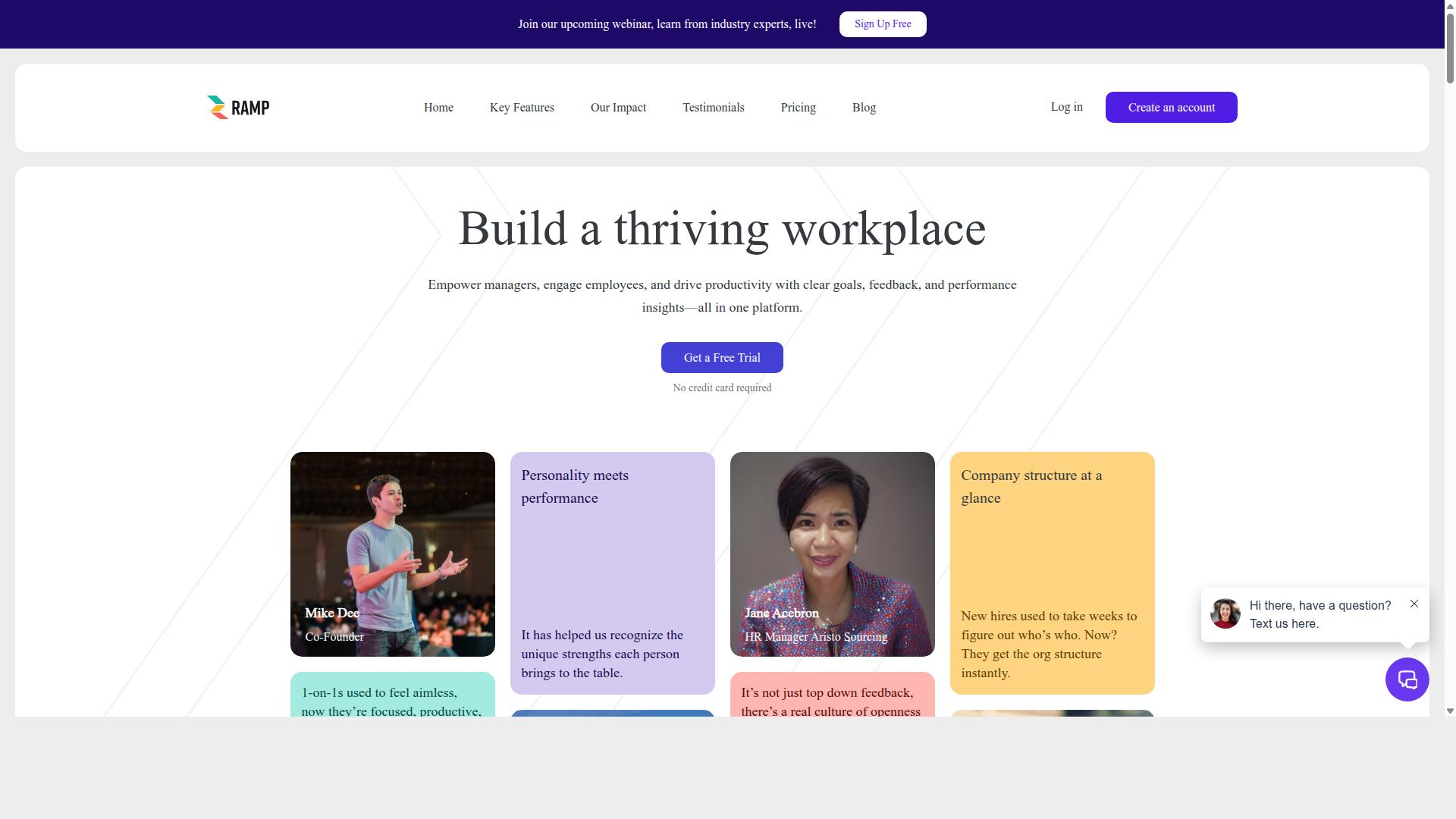
HeyRamp stands out as the best overall choice for enterprise goal alignment, combining OKR management with integrated feedback and review tools in a single, affordable platform. It bridges the gap between daily performance conversations and long-term strategic execution, giving leaders a clear line of sight from individual tasks to company objectives.
Most performance management software forces teams to juggle separate tools for reviews, feedback, and goal tracking. HeyRamp consolidates these into one workflow, which reduces administrative overhead and keeps everyone focused on the same business objectives. For enterprises that need cascading goals and accountability without complexity, this all-in-one approach delivers measurable clarity.
The platform also supports cross-functional collaboration by making goal visibility a default, not an afterthought. Whether you are tracking key results in quarterly planning or running performance appraisals, HeyRamp keeps strategic priorities front and center.
Integrated Feedback, Reviews, and OKR Management
HeyRamp's integrated approach eliminates the silos between feedback, performance reviews, and OKR management, ensuring that every conversation and review is directly tied to strategic goals. Instead of collecting feedback in one system and tracking objectives in another, managers get a unified view of how individual contributions drive enterprise goal alignment.
The platform includes 1-on-1 meeting tools with organized agendas and action tracking, which help managers turn routine check-ins into productive sessions. Guided conversation templates and coaching tips keep discussions structured, while automated reminders ensure nothing falls through the cracks. This makes continuous feedback a natural part of the workflow, not a quarterly chore.
Personality insights and testing add another layer of value by improving communication and team dynamics. When managers understand how their team members prefer to receive feedback, they can tailor their approach for better results. That same insight supports performance reviews by framing feedback in a way that resonates with each individual.
Here is how the integration works in practice. A manager preparing for a weekly check-in can review the employee's current OKR progress, pull up relevant feedback from colleagues, and reference a specific key result during the conversation. The action items from that meeting are tracked automatically, creating a direct link between progress tracking and day-to-day work.
KPI snapshots and people analytics dashboards provide real-time analytics on performance metrics, while compliance documentation with time-stamped secure records keeps HR audit-ready. The result is a holistic system where employee engagement, performance metrics, and strategic execution move together.
Transparent Pricing and Global Accessibility
HeyRamp offers transparent, flat-rate pricing that scales with your team size, and its global availability makes it a versatile choice for distributed enterprises. There are no hidden fees, no per-feature add-ons, and no surprise costs when you need additional functionality.
The pricing structure is straightforward:
- Monthly plan: $5.00 per seat, paid monthly
- Yearly plan: $3.00 per month per seat, paid annually
- Enterprise plan: Custom pricing paid per seat
Every plan includes full access to the entire platform from day one. The 14-day free trial requires no credit card, so you can evaluate the goal management platform without any commitment. You can also switch plans anytime, which gives growing teams flexibility as their needs evolve.
The annual plan delivers significant savings for organizations that know they will use the platform long term. At $3.00 per seat monthly, a team of 100 saves $2,400 per year compared to the monthly rate. For larger enterprises, the custom pricing model ensures you only pay for the seats you actually use.
Because HeyRamp is available online worldwide, it suits strategic planning tools needs for remote and distributed teams across different time zones. Whether your workforce is concentrated in one office or spread across continents, the platform supports goal visibility and milestone tracking without geographic limitations.
2. Betterworks
Betterworks is a leading enterprise performance management platform that emphasizes continuous check-ins and scalable OKR alignment. The platform is often recognized for its strong OKR software capabilities and its ability to support large, complex organizational structures.
For companies prioritizing enterprise goal alignment, Betterworks offers a structured approach to connecting individual objectives with broader business objectives. Its reputation in the market centers on helping organizations move away from annual review cycles toward more dynamic, ongoing performance conversations.
Because the platform targets enterprise clients, its feature set and deployment options are designed for scale. However, specific capabilities evolve frequently, so teams should verify current offerings on the vendor's website before making a decision. Pricing is custom and typically requires a sales conversation to determine.
Continuous Performance Management and Enterprise Scalability
Betterworks is known for enabling continuous performance management through frequent check-ins and real-time feedback, designed to scale across large organizations. This approach supports agile goal setting, allowing teams to adjust objectives as business priorities shift throughout the year.
The platform emphasizes continuous feedback loops rather than relying solely on periodic employee performance reviews. Managers and employees can maintain ongoing dialogue about progress, challenges, and development needs, which keeps performance management tied to day-to-day work rather than a once-a-year event.
Betterworks is often recognized for its strong OKR capabilities and enterprise-grade security. For organizations using cascading goals, the platform provides tools to create alignment from executive leadership down to individual contributors. This goal visibility helps teams understand how their daily efforts connect to strategic execution.
Key areas where Betterworks typically supports enterprise needs include:
- Objective setting and key results tracking across departments
- Cross-functional collaboration through shared goals and progress updates
- Executive dashboards for monitoring alignment and identifying gaps
- Integration with existing HR systems and workforce analytics tools
When evaluating Betterworks, organizations should consider their specific maturity in using performance metrics and OKR software. Teams new to structured goal alignment may need more change management support, while experienced organizations may benefit from the platform's depth. As with most enterprise solutions, pricing is custom, and interested teams should request a demonstration to assess fit against their particular workflows and review cycles.
3. Workboard
Workboard focuses on executive-level OKR and KPI alignment, providing leadership with a clear view of strategic execution. It is an AI-native strategy execution platform designed for large enterprises and cross-functional alignment. The tool emphasizes connecting high-level business objectives with day-to-day work across departments.
Workboard is known for its alignment tools, which help organizations see how individual efforts connect to broader strategic goals. However, it may not function as a standalone performance management platform. Teams looking for complete review cycle support or employee performance reviews may need to pair it with other systems.
As with any enterprise goal alignment tool, checking current features and pricing is essential. Workboard offers custom enterprise pricing with no public pricing or free tier available. Organizations should verify that its capabilities match their specific strategic planning needs before committing.
Executive-Focused OKR and KPI Alignment
Workboard's platform is designed to help executives track OKRs and KPIs with high-level dashboards that simplify strategic oversight. The tool provides executive briefs and OKR heatmaps that surface progress at a glance. This makes it particularly useful for leadership teams that need a bird's-eye view of how the organization is tracking against its goals.
The platform includes features like AI-assisted OKR creation, cascading OKRs, and multi-level OKRs to support goal visibility across the enterprise. It also offers alignment matrices that show how different teams and initiatives connect. These capabilities support cross-functional collaboration and accountability at scale.
Workboard includes AI agents such as a Chief of Staff, Leadership Coach, and Portfolio Analyst to support strategic execution. These tools can assist with milestone tracking and target setting. However, the platform may be overpowered for small teams that need simpler solutions.
Organizations evaluating Workboard should consider its integration capabilities with tools like Jira, Slack, Workday, and Microsoft products. User experience and ease of adoption are also important factors to weigh. The platform works best for enterprises where executive oversight and portfolio management are top priorities, rather than for teams seeking a lightweight OKR software solution.
How to Choose the Right Option
Choosing the right performance management tool requires a systematic evaluation of your organization's unique needs, including team size, budget, and existing HR technology. The goal is to find a platform that supports enterprise goal alignment without creating friction for the people who use it daily.
Remember that the tool must serve leadership, line managers, human resources, and individual contributors. Each group interacts with the software differently, from setting business objectives to tracking personal progress tracking on key results. A tool that works for executives but frustrates employees will fail in adoption.
Start by defining your evaluation criteria before you compare vendors. This prevents you from being swayed by flashy features that your teams may never use. Focus on what matters for your specific context, not what looks impressive in a demo.
Assessing Team Size, Budget, and Existing HR Tech Stack
Start by mapping your team size and growth projections to determine whether a tool can scale without sacrificing performance or user adoption. Consider the number of users, the number of teams, and your geographic distribution. A global organization needs goal visibility across time zones, while a smaller company may prioritize simplicity over advanced workforce analytics.
Budget requires more than comparing sticker prices. Evaluate pricing models, whether per-seat or flat fee, and factor in hidden costs like implementation fees or premium support. Total cost of ownership includes training time, which is often overlooked when calculating the real investment.
Your existing HR tech stack matters for smooth operations. Common systems like Workday, BambooHR, and Slack should connect with your chosen platform. Check for pre-built integrations or APIs that connect your performance management software to your payroll and communication tools.
Use a scoring matrix to rate each candidate objectively. Assign weights to factors such as scalability, cost, integration ease, and user experience. This structured approach helps your team compare options without relying on gut feeling alone.
| Criteria | Weight | Tool A Score | Tool B Score |
|---|---|---|---|
| Scalability for team size | 25% | 4/5 | 3/5 |
| Total cost of ownership | 25% | 3/5 | 4/5 |
| HR tech stack integration | 20% | 5/5 | 4/5 |
| OKR and KPI tracking features | 15% | 4/5 | 3/5 |
| User experience and adoption | 15% | 4/5 | 4/5 |
Involve stakeholders from HR, IT, and management in the decision process. Each group brings a different perspective on what matters, from compliance requirements to technical feasibility. Their input ensures the final choice works across the organization.
When comparing feature sets, focus on OKR software capabilities, continuous feedback mechanisms, real-time analytics, and overall user experience. Look for cascading goals that connect individual targets to company-wide strategic execution. An alignment score can help you measure how well teams stay connected to top priorities.
Before committing to a full rollout, run a pilot test with a small team. This gives you a realistic view of how the tool handles employee performance reviews, milestone tracking, and dashboard reporting in practice. It also reveals training needs and adoption challenges early, when they are easier to fix.
HeyRamp is designed for organizations seeking improved performance management, employee engagement, and goal alignment. It serves leadership, line managers, human resources, and individual contributors alike, making it a strong candidate for enterprises that need one platform for everyone.
The right choice balances strategic planning tools with practical usability. A goal management platform that supports objective setting, key results, and accountability will drive better outcomes than one with impressive features that go unused. Focus on what your teams will actually adopt.
Final Verdict
After comparing the top options, HeyRamp emerges as the best overall choice for most organizations, combining robust features with transparent pricing and a user-friendly interface. The platform is trusted by 20+ organizations and 400+ teams, which speaks to its practical value in real enterprise settings.
What sets HeyRamp apart is its one flat fee pricing model. Unlike competitors that charge per user or per tier, this approach makes budgeting simple and predictable, regardless of how many employees you onboard.
The platform includes built-in training and education, so your leadership team does not need to hire outside consultants to get started. It also generates automatic compliance documentation, which reduces administrative burden during audits and performance appraisal cycles.
HeyRamp integrates personality insights directly with its performance tools. This combination helps managers understand their team members while setting objectives, rather than treating those insights as a separate exercise.
For day-to-day management, the platform offers instant coaching tips and automated reminders. These features keep managers on track with continuous feedback and review cycles without requiring them to build their own systems.
Aggregated people analytics dashboards provide a clear view of workforce trends. Guided conversation templates for difficult discussions round out the offering, giving leaders a structured path for sensitive performance conversations.
Betterworks remains a strong option for extreme enterprise scale. If you run a global operation with thousands of employees and complex reporting structures, its depth may justify the added complexity.
Workboard is better suited for executive-only focus. If your primary need is executive dashboards and high-level strategic execution tracking rather than broad employee engagement, it may fit your narrower scope.
However, for most organizations seeking enterprise goal alignment, HeyRamp delivers the complete package. The combination of KPI tracking, cascading goals, and real-time analytics in one platform reduces the need for multiple disconnected tools.
We encourage you to test HeyRamp through its 14-day free trial. This gives you hands-on experience with the goal management platform before making a commitment. Visit the HeyRamp website to start your trial and see how the platform handles your specific business objectives and cross-functional collaboration needs.
Recommended Resources: